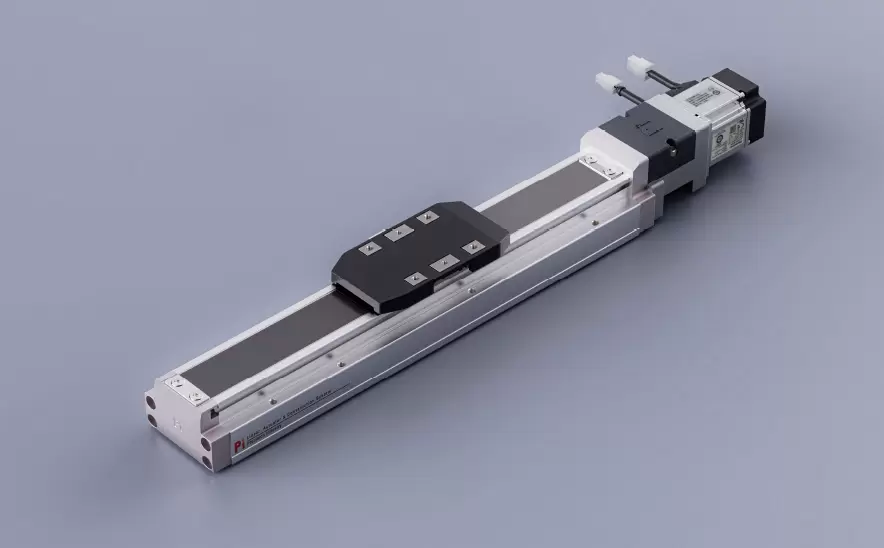
Motor Bottom Side
Repeatability:±0.005/0.01mmHorizontal Load:150kgVertical Load:55kgMaximum Speed:2000mm/sTravel Range:100-1500mm

 Current location:Home > Company > News > Latest news > How to Set Up a Precision Positioning Slide Table for Precision Machining
 Date: Apr 15 2026
Precision machining demands extremely accurate and repeatable motion. A well-set-up precision positioning slide table can make the difference between high-quality parts and inconsistent results. While these systems are engineered for exact performance, their accuracy is only fully realized when installed and prepared correctly.
Whether you’re working in a small machine shop or a high-tech manufacturing line, following a careful setup process ensures that your slide table delivers consistent precision and smooth operation.
Before any installation begins, select a slide table that matches your machining requirements. Factors to consider include:
Travel range: Ensure the table can cover the full distance required for your workpiece
Load capacity: Include the weight of the workpiece, fixtures, and tools
Positioning accuracy and repeatability: Match the system to the tolerance requirements of your machining process
Drive type: Consider ball screw, belt, or linear motor drives based on speed and load needs
Choosing the right equipment upfront prevents unnecessary adjustments and ensures optimal performance.
A precision slide table can only perform as well as its foundation allows. A flat, rigid, and vibration-free base is essential for consistent results.
Tips for preparing the mounting surface:
Use a surface plate or machined machine table with minimal deviation
Secure the base with evenly tightened bolts to prevent warping
Ensure the mounting area is free from dust, debris, or oil
A stable base reduces unwanted motion and ensures the slide table moves precisely along its intended path.
Alignment is critical for precision machining. Even a small tilt or misalignment can affect the final part dimensions.
Key alignment steps include:
Level the slide table using a precision spirit level or dial indicator
Align the table with other connected equipment or machine axes
Check for parallelism between the slide table guide rails and the machine spindle
Proper alignment minimizes mechanical stress and ensures the table moves smoothly.
The placement of your workpiece and fixtures affects both precision and stability. Improper mounting can create uneven loads and reduce repeatability.
Best practices include:
Position the workpiece as close to the center of the table as possible
Secure all fixtures firmly to prevent movement during machining
Avoid excessive cantilevering of the workpiece or fixtures
Distribute weight evenly to reduce strain on the guide system
Balanced and secure mounting allows the slide table to maintain accuracy over repeated cycles.
Slide tables often allow control over speed, acceleration, and deceleration. Optimizing these settings helps prevent vibration and mechanical stress during machining.
Recommendations:
Use smooth acceleration and deceleration profiles
Avoid speeds that exceed the recommended load capability
Test motion with the actual load to ensure smooth operation
Fine-tuning these settings contributes to both accuracy and repeatability.
Before machining begins, ensure all moving parts are clean and properly lubricated. Friction or debris can affect motion consistency.
Maintenance steps:
Wipe guide rails free of dust or metal chips
Apply the manufacturer-recommended lubricant to moving parts
Verify that the drive system and bearings are free of binding or resistance
Regular inspection keeps the table moving smoothly and preserves long-term precision.
Before starting production, perform a controlled test run:
Move the slide table through its full travel range
Check for smooth movement without vibration or stiction
Verify positioning repeatability at key points along the travel path
Make any minor adjustments to alignment or motion settings as needed
A test run ensures that the system is ready for precision machining tasks.
Setting up a precision positioning slide table for machining requires careful attention to equipment selection, mechanical stability, alignment, load balance, and motion settings. Following these steps ensures that the slide table delivers smooth, repeatable, and accurate motion for high-quality machining results.
By taking the time to set up your system properly, you protect both your investment and your machining accuracy, ensuring consistent performance across every part you produce.